LEVEL UP PEST LIBRARY · P035
Diplopoda — many short legs, usually an outdoor decomposer.
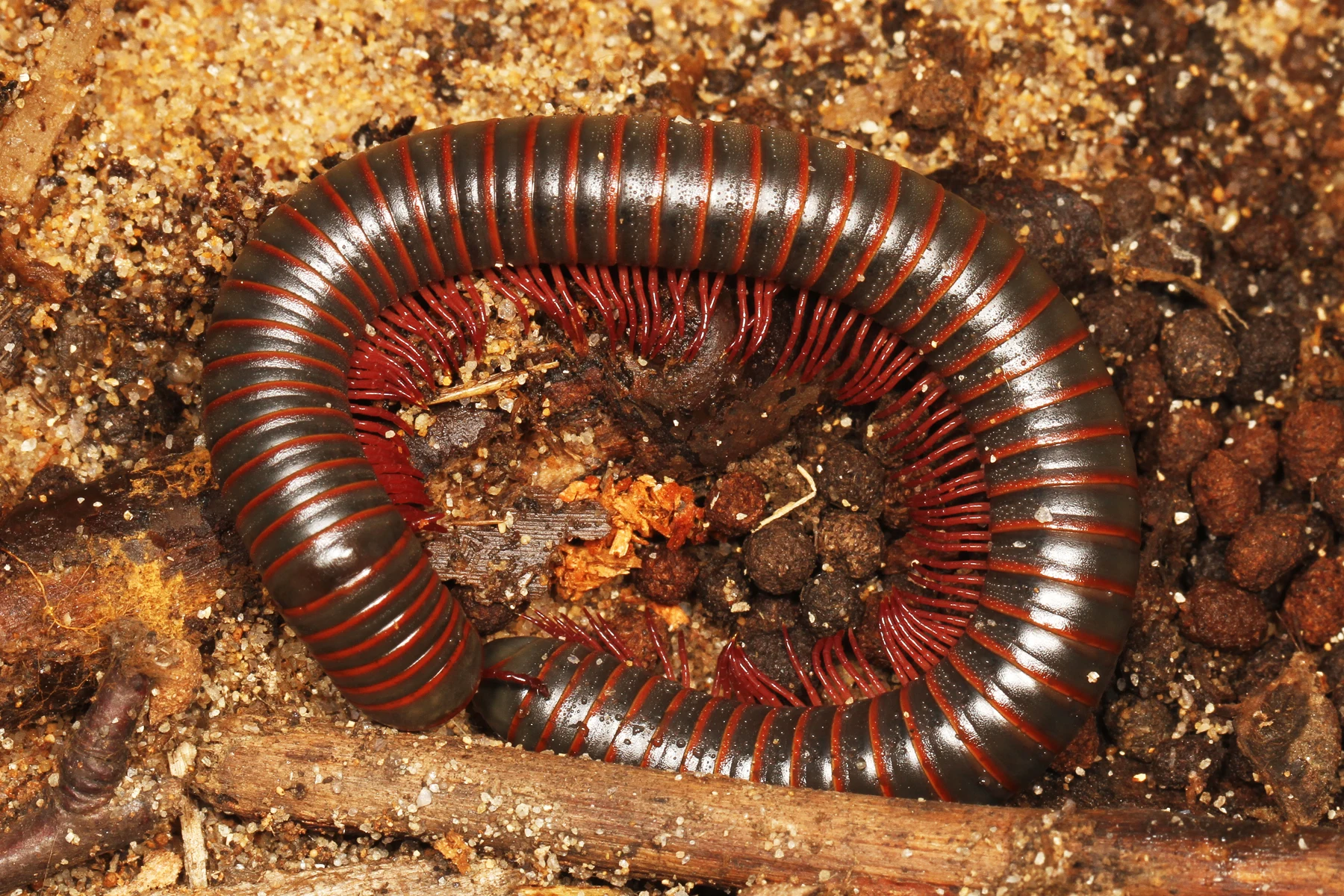
Photo: Judy Gallagher — Wikimedia Commons: Millipede – Narceus americanus or annularis, Leesylvania State Park, Woodbridge, Virginia.jpg — CC BY 2.0. Proportionally resized and converted to WebP; no crop or specimen alteration. Embedded metadata omitted.
Millipedes are arthropods, but not insects. Many have a rounded, cylindrical body; others have flattened sides. Numerous short legs move in coordinated waves. Most trunk rings carry two pairs of legs, unlike the single pair on each leg-bearing centipede segment.
The photograph shows Narceus americanus or Narceus annularis from Virginia. The original source does not separate those species, and neither do we. A photograph of one curled individual is not a species-level identification of every millipede.
Millipedes generally feed on decomposing organic material in sheltered, moist settings. Leaf litter, decaying wood and similar habitat support their ecological role. Many curl when disturbed; defensive secretions vary among groups, so avoid handling unfamiliar specimens.
Eggs and developing young belong in suitable habitat. Indoor appearances after wet weather or a change in outdoor conditions can reflect movement through door gaps and other openings. A few arrivals do not establish indoor reproduction or a plumbing leak.
Notice whether findings cluster at a garage threshold, exterior door or lower-level room. Record the timing and whether individuals are alive, rather than relying on a single photograph of a dried specimen.
Repeated findings can justify checking nearby damp organic debris, entry gaps and independently observed moisture. The insects are a reason to inspect the setting, not a diagnosis of structural damage.
Maintain door sweeps and accessible exterior seals. Reduce unnecessary accumulations of wet leaves or debris immediately against entrances while preserving appropriate landscaping. Correct a verified drainage or leak problem through the right trade.
Persistent large arrivals or inaccessible entry routes may benefit from a focused assessment. Removing individual wanderers without correcting access can leave the same pattern in place; no single housekeeping step guarantees permanent exclusion.
No. It has a segmented body and jointed legs. Wormlike shape alone misses the feature that distinguishes this arthropod.
Many do, but behavior varies. Do not provoke one to make it match a photograph.
No. Its source explicitly retains Narceus americanus or Narceus annularis. We preserve that uncertainty.
No. Outdoor conditions and entry openings can explain occasional arrivals. Investigate moisture independently.
When entries recur, numbers increase, or the access route and contributing conditions remain unclear despite reasonable maintenance.
Send an existing clear photograph and describe where and when the insect appeared. Include the whole body where safely possible. Photographs may support preliminary identification without establishing the exact species, entry point or property condition. Do not handle unfamiliar arthropods or enter unsafe areas to obtain evidence.
These are third-party identification references, not Level Up field photographs. They are not displayed at one physical scale. Source locations do not establish local prevalence. Each photograph retains visible creator and license credit; any ShareAlike obligation applies to the qualifying image adaptation, not the whole website.

