PEST LIBRARY · P042
Mus musculus — identification, evidence and prevention
Mus musculus
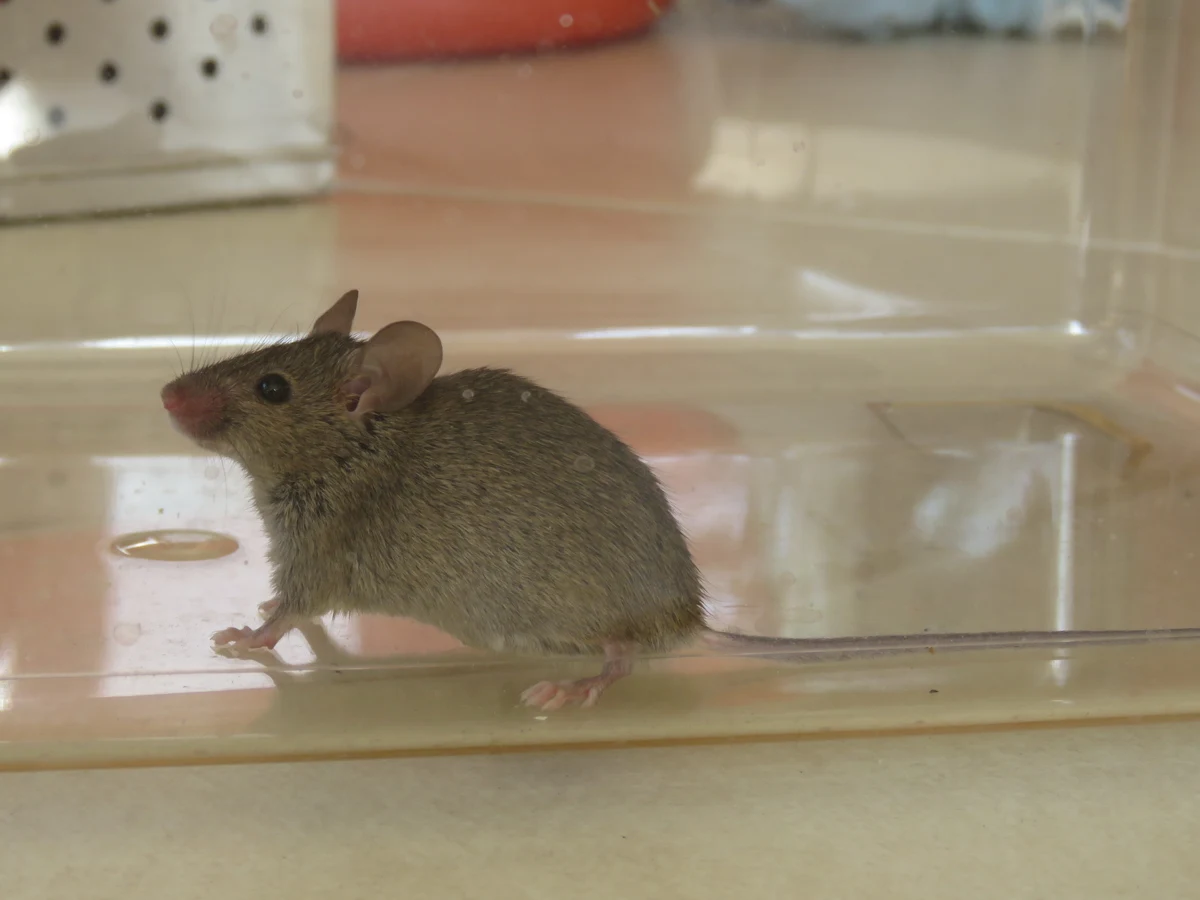
Mus musculus — Donald Hobern. Original source; CC BY 2.0. Resized and converted to WebP; no crop or retouching.
Small body, prominent ears and a pointed muzzle are useful starting clues. Adults are commonly about 5–7 inches from nose to tail tip. The sparsely haired tail is an important feature; a small rodent is not automatically a house mouse.
Sheltered nests may be made from shredded paper or similar material near food. Look for damaged packaging and repeated evidence around cabinets, garages or storage—not just an animal’s color.
The reference photo shows a mouse in an enclosure. It is not a Level Up field photograph.
Mus musculus

Mus musculus — Matt Frye / NY State IPM Program at Cornell University. Original source; CC BY 2.0. Resized and converted to WebP; no crop or retouching.
Typical length: About ⅛–¼ inch (3–6 mm)
Small, elongated pellets, commonly with tapered ends; often compared with dark grains of rice.
The Cornell photograph shows evidence in its setting, without a ruler. It does not establish the age or number of animals.
Photographs are not displayed at a common physical scale. Do not handle or reposition droppings for identification. Size and shape overlap; photographs cannot reliably establish the species, number of animals or whether activity is current.
An exterior sighting is a reason to look calmly at the setting. Is food available? Is shelter close to the building? Are there plausible openings and corresponding indoor signs?
A rat crossing a yard does not establish a nest in the house. Likewise, an indoor sighting does not reveal the original entrance. Location, timing and repeated observations help direct an appropriate inspection without jumping to a conclusion.
Removing an animal and limiting future access are different tasks. Trapping or baiting alone does not repair an opening or make a building permanently rodent-proof. Exclusion addresses usable access routes alongside food, shelter and activity already inside.
A practical plan combines appropriate repairs, sanitation, monitoring and attention to exterior conditions. Follow-up checks help show whether evidence recurs and whether repaired barriers remain sound. The work and follow-up should match the findings and agreed scope.
Do not sweep or vacuum untreated rodent droppings, urine or nesting material. Do not crush or collect pellets for identification. Keep children and pets away from the affected area.
For routine cleanup, CDC advises rubber or plastic gloves and thoroughly wetting the material with an appropriate disinfectant. Allow five minutes, or the time specified on the product label, before wiping up; disinfect affected hard surfaces and wash hands afterward. Follow the full guidance for the particular material and setting.
For homes or outbuildings, CDC also advises ventilating for 30 minutes and leaving the area during ventilation before cleanup. Heavy contamination, difficult spaces and affected ventilation systems require additional precautions or appropriate professional assistance.
No. Compare body proportions, ears, muzzle and the tail where visible. An obstructed photograph may leave identification uncertain.
No. Size and shape are clues that should be considered with other evidence. Do not handle pellets for identification.
No. Look for related indoor evidence and possible access rather than assuming interior occupancy.
Not necessarily. Keep a dated record; appearance alone does not reliably establish age or current activity.
No. Appropriate exclusion and maintenance address access, food and shelter alongside management of animals already present.
Share an existing photograph and where the evidence appeared. Do not disturb nests or contaminated materials to obtain a picture.


