LEVEL UP PEST LIBRARY · CATEGORY 11
A tiny fly on the window is only one clue. Its shape, behavior and development needs can point toward a plant pot, a fermenting residue, an organic film—or an entry from outdoors. Not every small fly is a gnat, and more than one source may be involved.
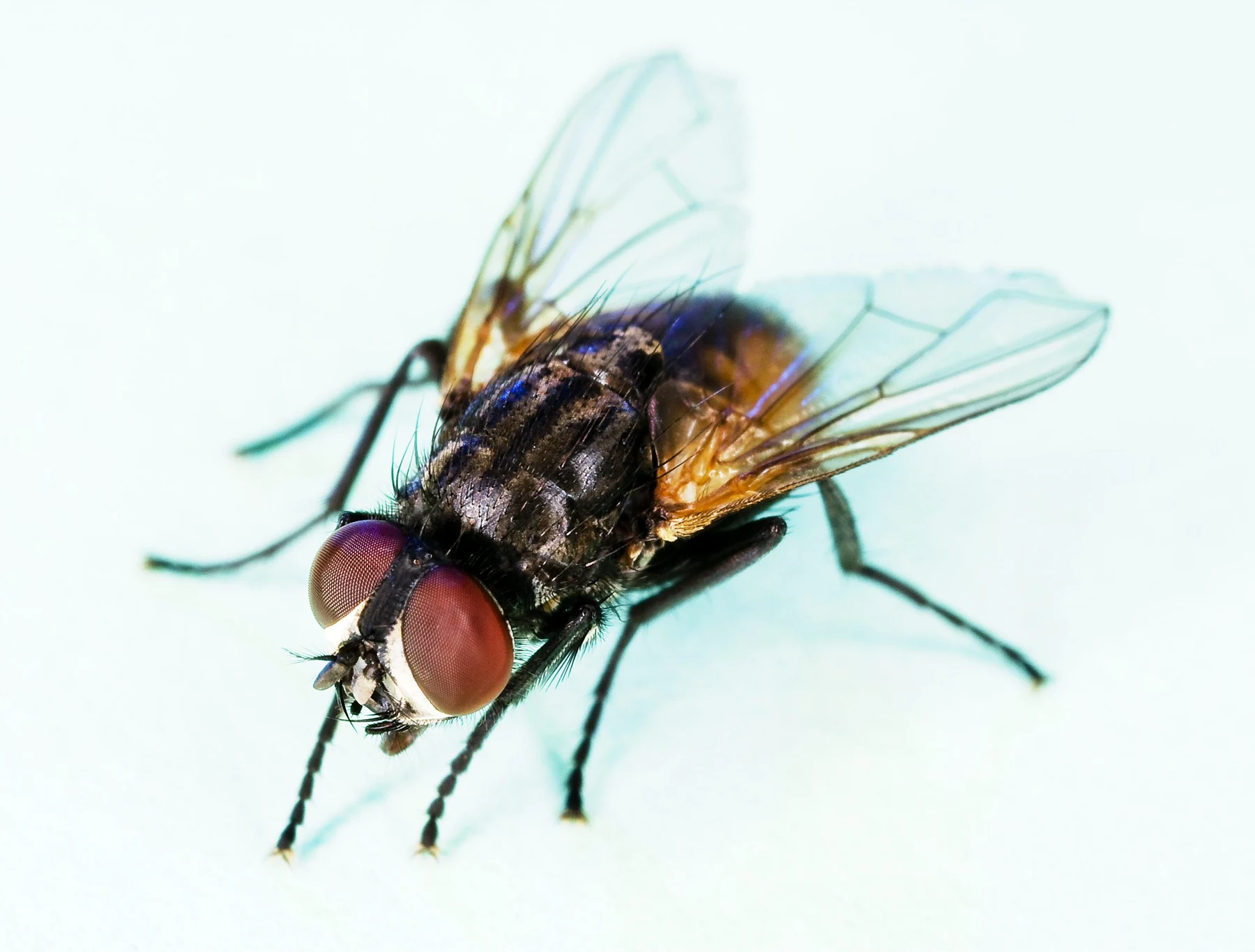
Photo: Stephen Ausmus / USDA-ARS, via USDAgov; Commons edits by Chiswick Chap — Common house fly, Musca domestica.jpg — CC BY 2.0. Proportionally resized where needed and converted to WebP; no additional crop or specimen alteration. Existing Commons crop and background lightening retained.
At roughly 6–7 mm long, this familiar fly is larger and more robust than many kitchen “gnats.” Four dark lengthwise stripes on a gray thorax are useful clues. Compare the whole insect: other gray flies can look similar.
Suitable moist, decaying organic material supports larval development. Adults can enter through doors or screens from an outdoor source; an indoor sighting is not proof of indoor breeding.
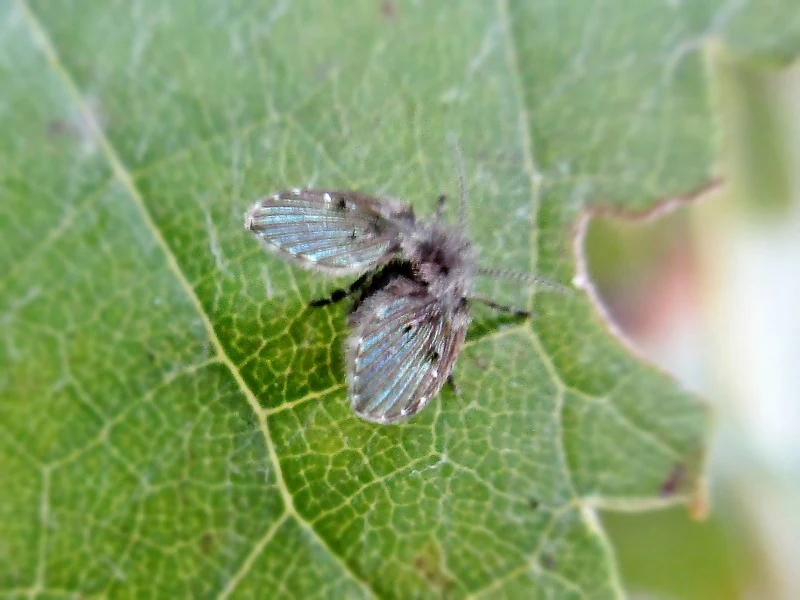
Photo: Bj.schoenmakers — Clogmia albipunctata (Drain fly), Arnhem, the Netherlands.jpg — CC0 1.0. Proportionally resized where needed and converted to WebP; no additional crop or specimen alteration.
A fuzzy body and broad hairy wings give these small flies a mothlike outline, often with the wings held like a roof. Many adults are only about 2–3 mm long. The photograph represents Clogmia albipunctata, not every drain fly.
Moist organic films can support development. Bathrooms and kitchens are useful search locations, but a resting fly beside a drain does not establish where it grew.
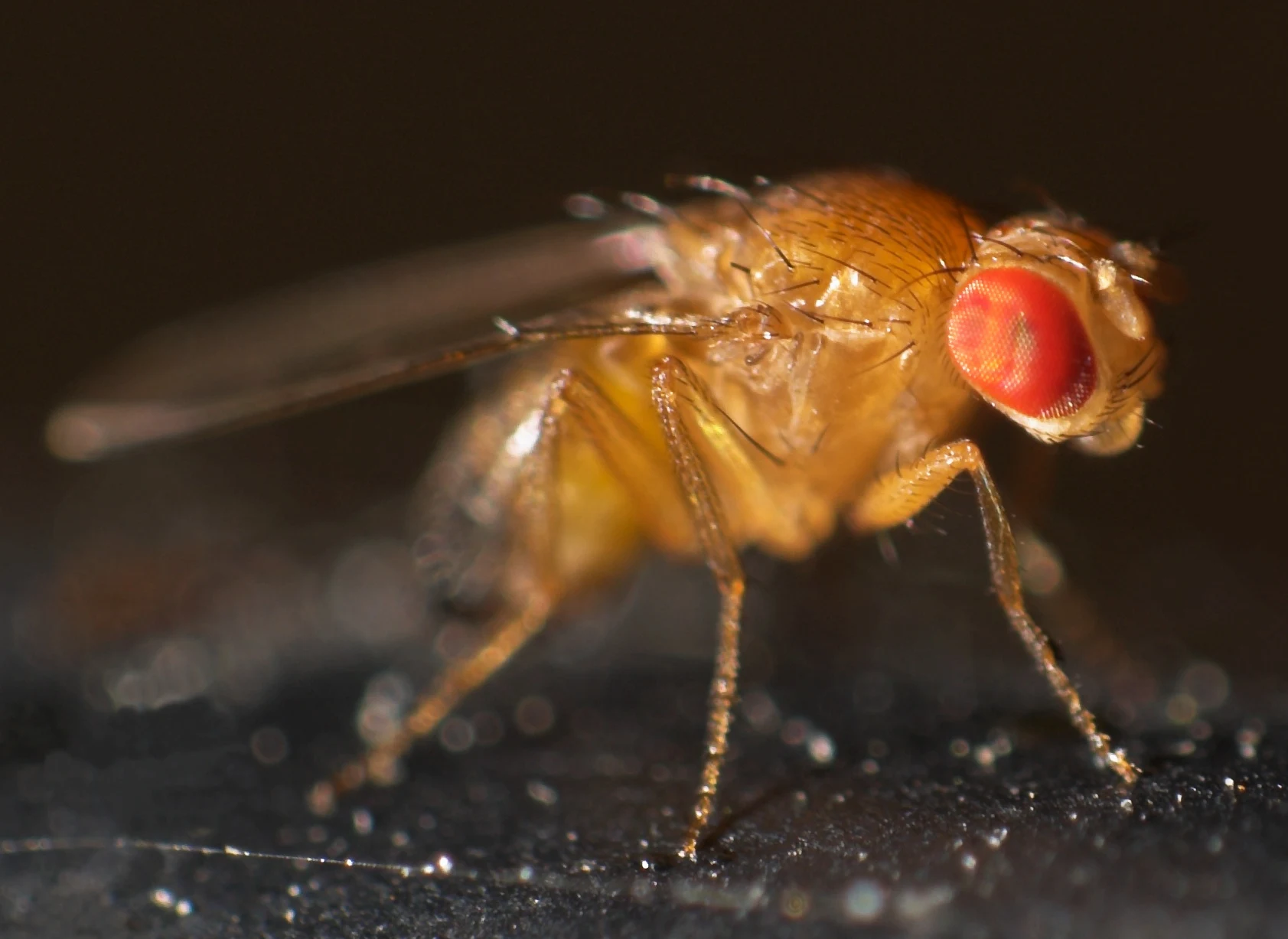
Photo: Mr.checker — Drosophila melanogaster.jpg — CC BY-SA 3.0. Proportionally resized where needed and converted to WebP; no additional crop or specimen alteration.
These small flies are often around 3 mm long, with tan-to-brown bodies and conspicuous red eyes in familiar species. Eye color and size are clues, not a complete identification. This reference is Drosophila melanogaster.
Fermenting produce, beverage residues and similar materials can support activity. Another small fly beside fruit may belong to a different group.
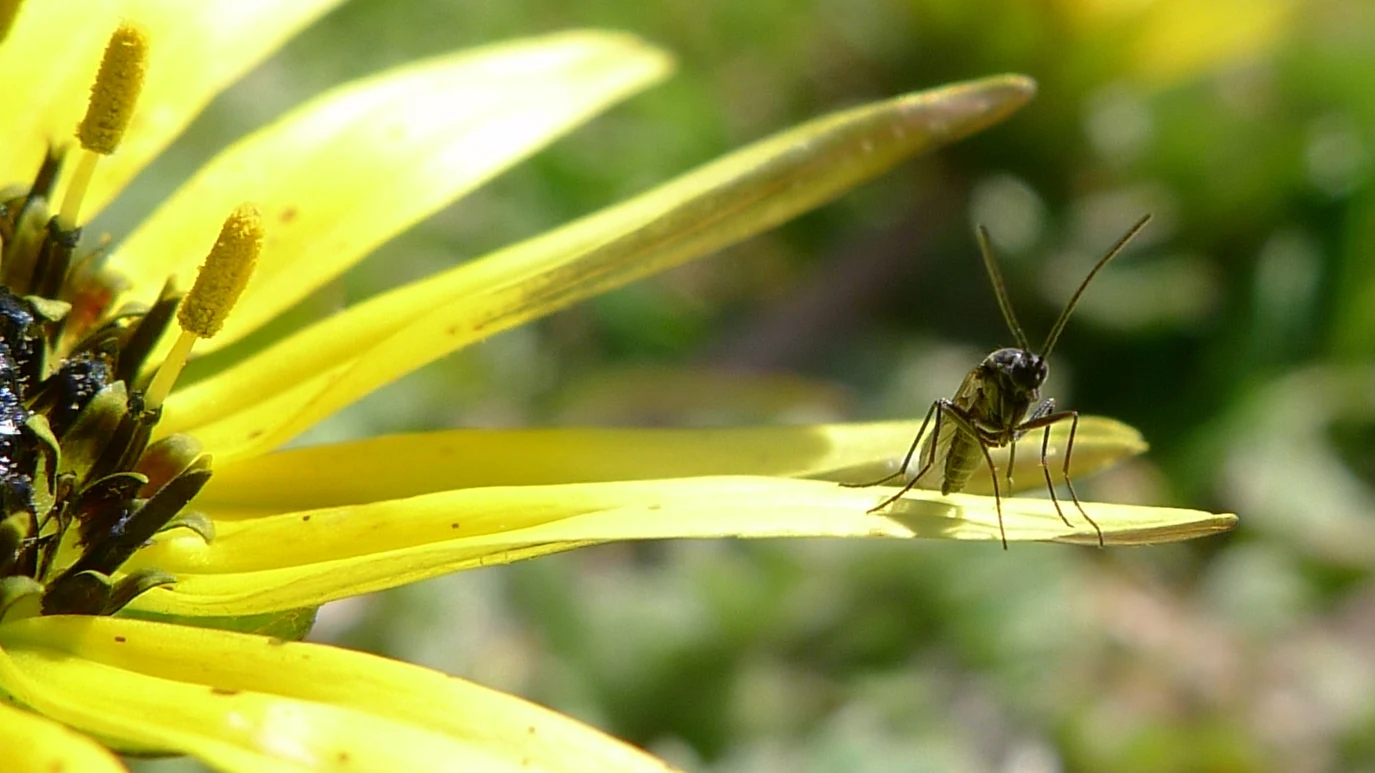
Photo: John Tann — Dark-winged Fungus Gnat (8009213579).jpg — CC BY 2.0. Proportionally resized where needed and converted to WebP; no additional crop or specimen alteration.
A delicate dark body, slender legs and long antennae can resemble a tiny mosquito. Common indoor examples are about 1.5–3 mm long. The source identifies this photographed male to family, not species.
Many fungus gnats develop in moist organic growing media. A plant nearby makes the pot worth checking; it does not prove the larvae are there.
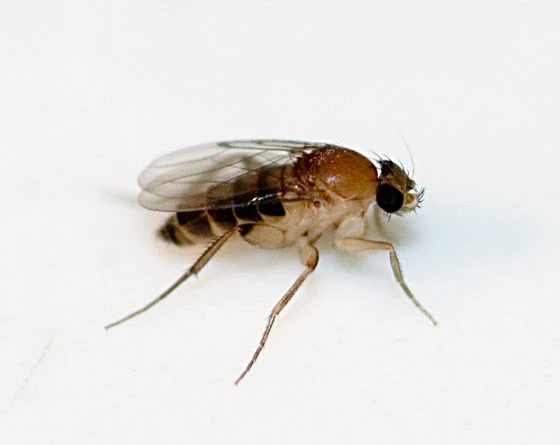
Photo: Charles Schurch Lewallen — Megaselia scalaris.jpg — CC BY 3.0. Proportionally resized where needed and converted to WebP; no additional crop or specimen alteration.
The arched thorax and quick running movements are helpful clues. Many indoor phorids are only a few millimeters long; a side view is often more useful than color. Megaselia scalaris is the representative shown here.
These flies can develop in varied moist, decaying organic materials, including concealed sources. Persistent activity deserves investigation, but flies alone do not diagnose a broken sewer line.
A Visual Guide to Identifying Small Flies and Their Potential Breeding Sources
Adults resting near a sink may be drain flies, fruit flies or another group. Some moth-fly larvae develop in suitable moist films inside drains or associated plumbing. The location is a lead, not a diagnosis.
Record which openings and rooms are involved. Have accessible organic buildup evaluated and removed safely where appropriate. Do not mix cleaning chemicals or pour insecticides into a drain. Recurrence after surface cleaning is a reason to verify the source, not keep adding chemicals.
Fermenting fruit, a partly emptied drink, recycling residue or a spill beneath equipment can be more important than the clean countertop above it. These are useful places to investigate when fruit flies are identified.
Inspect stored produce, remove spoiled material and clean containers and accessible residues. A fly at food does not establish its group or prove that food is its development site. Check more than the fruit bowl.
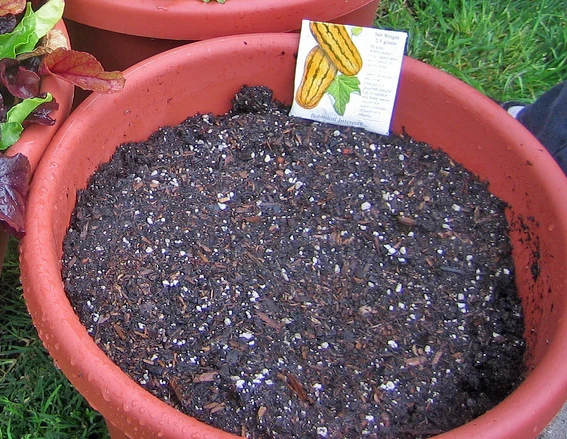
Photo: Chris Radcliff; color correction and crop by Daniel Case — Potting soil.jpg — CC BY-SA 2.0. Proportionally resized where needed and converted to WebP; no additional crop or specimen alteration. Existing Daniel Case color correction and crop retained.
Persistently damp growing media can support fungi and organic material used by many fungus-gnat larvae. Adults rising from a pot or recurring nearby help focus the search. The photograph shows potting soil only, not larvae or a confirmed infestation.
Review watering and drainage in a way that suits the plant. Avoid leaving media unnecessarily wet. Moist soil alone is not proof; examine the insects and their association with particular pots before blaming every houseplant.
House flies and other larger flies can develop in suitable moist waste or decaying material. Waste containers, spilled animal feed or an overlooked bag may deserve attention, while many adults simply arrive from outside.
Keep waste contained and remove accessible decaying material promptly. Different flies use different substrates: do not label every garbage-associated fly a house fly or open a wall based on one sighting.
Repeated phorid activity may lead an inspection toward concealed moist organic material, accumulated waste or a verified plumbing leak. These are possibilities, not interchangeable explanations.
Map the locations and timing, note independently observed moisture or odors, and involve appropriate professionals for inaccessible areas. Fly sightings do not establish sewage leakage, structural damage or a health-code violation.
Adults can enter through open doors, gaps and damaged screens. Repeated activity at a busy entrance may reflect access from an outdoor source rather than larvae inside the room.
Compare entry activity with observations of immature stages or emergence from a specific material. Maintain screens and door closure where practical. Indoor and outdoor sources can coexist, so one corrected opening may not answer the whole problem.
Egg → Larva → Pupa → Adult
The flying adult is not the only stage present. Larvae use suitable development materials, and pupae can remain after the adults you saw have been removed. Timing depends on the group, temperature and conditions; there is no single fly timetable.
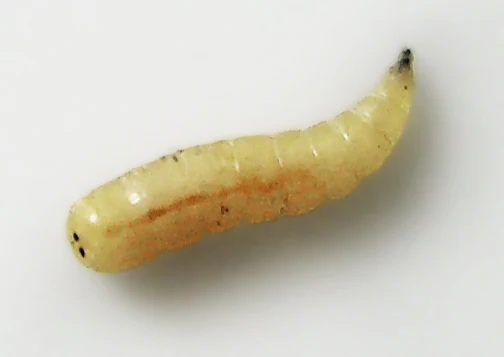
Photo: Pavel Krok — Fliegenlarve.jpg — CC BY-SA 3.0. Proportionally resized where needed and converted to WebP; no additional crop or specimen alteration.
This close view illustrates a fly larva. Although the source names a house fly, species was not independently established here; the image is used only for the broader developmental comparison.
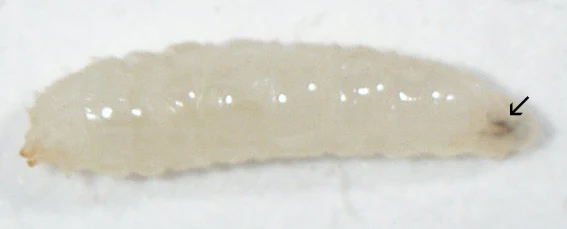
Photo: J. Albert Vallunen — Drosophila 2nd instar larva.jpg — CC BY-SA 2.5. Proportionally resized where needed and converted to WebP; no additional crop or specimen alteration.
The source explicitly identifies this second-instar larva as Drosophila melanogaster. The arrow indicates mouthparts. It is a magnified reference, not a life-size specimen or a drain-fly larva.
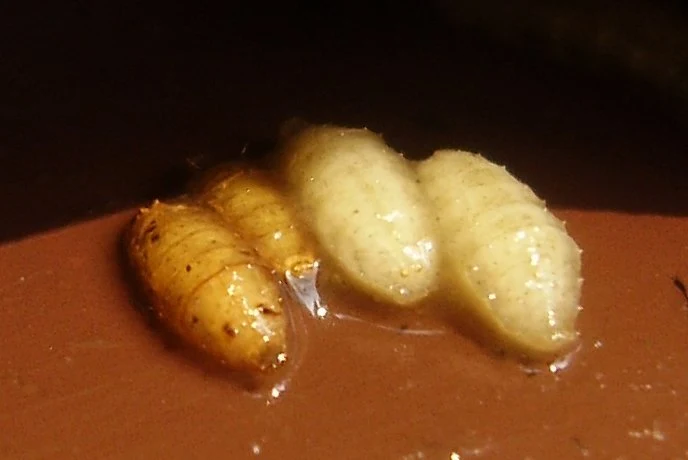
Photo: RickP — Fruit fly pupae 01.jpg — CC BY 2.5. Proportionally resized where needed and converted to WebP; no additional crop or specimen alteration.
The reference shows fruit-fly pupae with different coloration. This is a transformation stage, not a batch of eggs. The caption does not assert a species identification.
Removing visible adults can reduce annoyance without removing the material supporting the next generation. Source correction, access prevention and monitoring answer different parts of the problem.
Look for: A robust gray fly with four thoracic stripes.
Consider: Waste, decaying material and outdoor access.
Do not conclude: Every indoor adult developed indoors.
Look for: Fuzzy body and broad hairy wings.
Consider: Suitable moist organic films.
Do not conclude: The nearest drain is the source.
Look for: Small tan/brown body; often red eyes.
Consider: Fermenting produce and beverage residues.
Do not conclude: Every kitchen fly is a fruit fly.
Look for: Slender dark body, long legs and antennae.
Consider: Moist organic growing media.
Do not conclude: Every damp pot contains larvae.
Look for: Arched thorax and scuttling behavior.
Consider: Varied or concealed moist organic material.
Do not conclude: A sewer pipe must be broken.
A room may have several sources, or the same material may become suitable again after cleaning. Adults can also enter from outside while immature stages remain indoors. That combination can make a single action seem ineffective even when it addressed one real contributor.
Keep a simple record of locations, numbers and recent maintenance. Compare activity before and after a specific correction. Monitoring helps decide where to look next; it is not a promise that all activity will stop on a fixed date.
House flies can transfer contamination from waste to food, so food protection and waste handling matter. That does not mean every fly carries a particular pathogen or that a sighting establishes illness.
Fruit flies point attention toward suitable fermenting material; drain flies toward moist organic films; fungus gnats often toward growing media. A fungus gnat at a well-cared-for plant is not a sanitation accusation. Phorids call for careful source investigation without an automatic plumbing diagnosis.
In restaurants and managed buildings, keep observations and maintenance records useful to the people responsible for cleaning, drainage, waste and access. A pest photograph is not a regulatory finding.
Handle food waste promptly, clean beverage spills and maintain recycling containers. Include accessible places beneath and behind equipment, not only visible counters.
Review plant watering, drainage and verified leaks. Remove suitable organic buildup safely; leave inaccessible plumbing and structural work to appropriate help.
Maintain screens, seals and doors. Coordinate waste storage and frequently opened entries with the people who use the building.
When activity persists, identification and a focused property assessment can clarify the next correction. Service should match the findings, with scope and follow-up agreed in advance.
The cleaned surface may not be the development site. Residue can remain under equipment, in a recycling container or in another room, and existing immature stages may still produce adults. Identify the group and follow the pattern of activity before assuming the first cleaning failed.
Fruit flies are relatively smooth-bodied and familiar species often have red eyes. Drain flies look fuzzy, with broad hairy wings. A close, well-lit photograph can help distinguish the groups; a distant speck cannot reliably establish a species.
No. Adults can rest near a drain after developing elsewhere. The drain and its associated organic films are possibilities to inspect, not a conclusion. Look for evidence tying development to the specific location.
Fungus gnats are one possibility when growing media remains moist. Check the adult features and the association with particular pots. Other small flies can visit plants, and a damp pot by itself is not proof of an infestation.
Seek help when identification is unclear, activity continues after reasonable source corrections, or a suspected source is concealed or unsafe to access. A useful evaluation connects the insect, property conditions and evidence; it should not begin by assuming a sewer defect.
Send a clear existing photograph and describe where the flies appear, how they move, and whether you have seen immature stages. A close view and a wider view of the setting can help. Photographs may narrow the group without establishing a species or development source.
Level Up can help assess the evidence and relevant property conditions. Any corrective service and follow-up should follow the agreed recommendations and scope. Do not open unsafe voids or disturb electrical or plumbing systems to obtain a picture.
These are third-party reference photographs, not Level Up field records or evidence from a Hampton Roads property. Images are not displayed at a common physical scale. Credits identify creators, source files, licenses and modifications. ShareAlike applies to qualifying adaptations of the credited images, not to the entire website.


